What retirement gift can a team give without turning it into a joke?
Choose a respectful retirement gift with meaningful places, a clear team budget and practical printing arrangements.
A good retirement gift recognises a person’s life beyond their job. Start with something they genuinely enjoy, then add a specific memory from the team. A typographic country map can work particularly well when places connect those two parts of their story: where they grew up, began work, met colleagues or hope to spend more time. It needs a real connection, rather than a random destination chosen because it looks attractive.
Before buying anything, find out whether they would enjoy a keepsake at home. Some people would prefer a shared meal or a contribution towards an existing hobby. A personal poster is a good choice for someone who likes meaningful wall art; it is less suitable for someone actively clearing their walls. Here is a practical way to make that decision and organise the gift without a committee that never reaches an answer.
Ask about the next chapter without planning it for them
For a team with shared memories in United Kingdom, London, Leeds and Bristol could form a starting shortlist. Use those towns only if they belong to the recipient’s actual story. Ask someone who knows the person to confirm the connection; a smaller, accurate selection is better than using a list copied from a guide.
Retirement does not automatically mean travel, gardening or unlimited free time. Ask an ordinary question about what they are looking forward to. Listen for concrete details: returning to a particular town, seeing relatives more often, revisiting familiar places or finally arranging a study. Those clues are more useful than a novelty slogan about escaping work.
Choose a colleague who knows the recipient well to check the idea discreetly. They do not need to reveal the whole surprise. Knowing whether the person likes framed prints, has space for one and feels happy about the occasion is enough. If the departure feels complicated, keep both the gift and the presentation modest. Warm appreciation usually travels better than forced cheerfulness.
Give one person responsibility for the budget
Decide who collects contributions, who prepares the design and who checks the finished result. These can be different people, but one organiser should hold the final list. Set a clear closing date before the presentation. Contributions should be voluntary, and the card should welcome messages from people regardless of whether they contributed money.
Work out the whole cost before collecting: the digital design, printing, a suitable frame if wanted, and any local transport. YourLovely.Place supplies digital files, so the website price is not the price of a finished framed gift. Ask the print shop for a quote first. Keeping a small reserve for a proof or a replacement mount is more useful than spending everything on the largest format.
Choose places with a reason
Make a short list of meaningful towns before opening the designer. One might be the place where their career began, another the town of a memorable project, and another a place they actually want to return to. You do not need to represent every office, assignment or journey. Three well-chosen places can tell a clearer story than a crowded list.
Ask two colleagues to check the list for accuracy and tact. A town linked to a difficult period may not belong in a celebratory present. Avoid guessing where the recipient was born or plans to live. If you are unsure, choose places connected to shared experiences that they have spoken about positively. Do not use a map to announce a private plan that they have not shared.
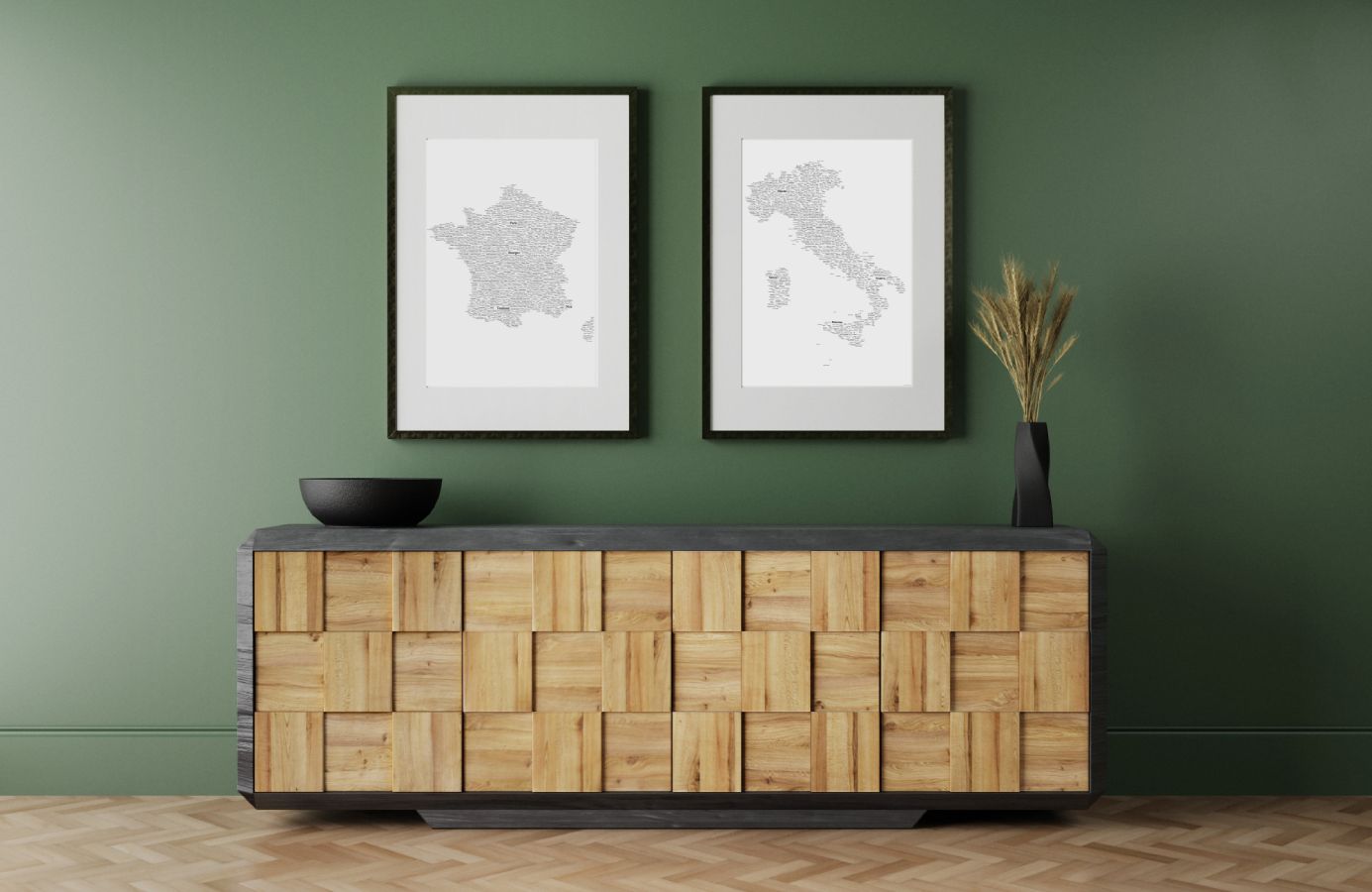
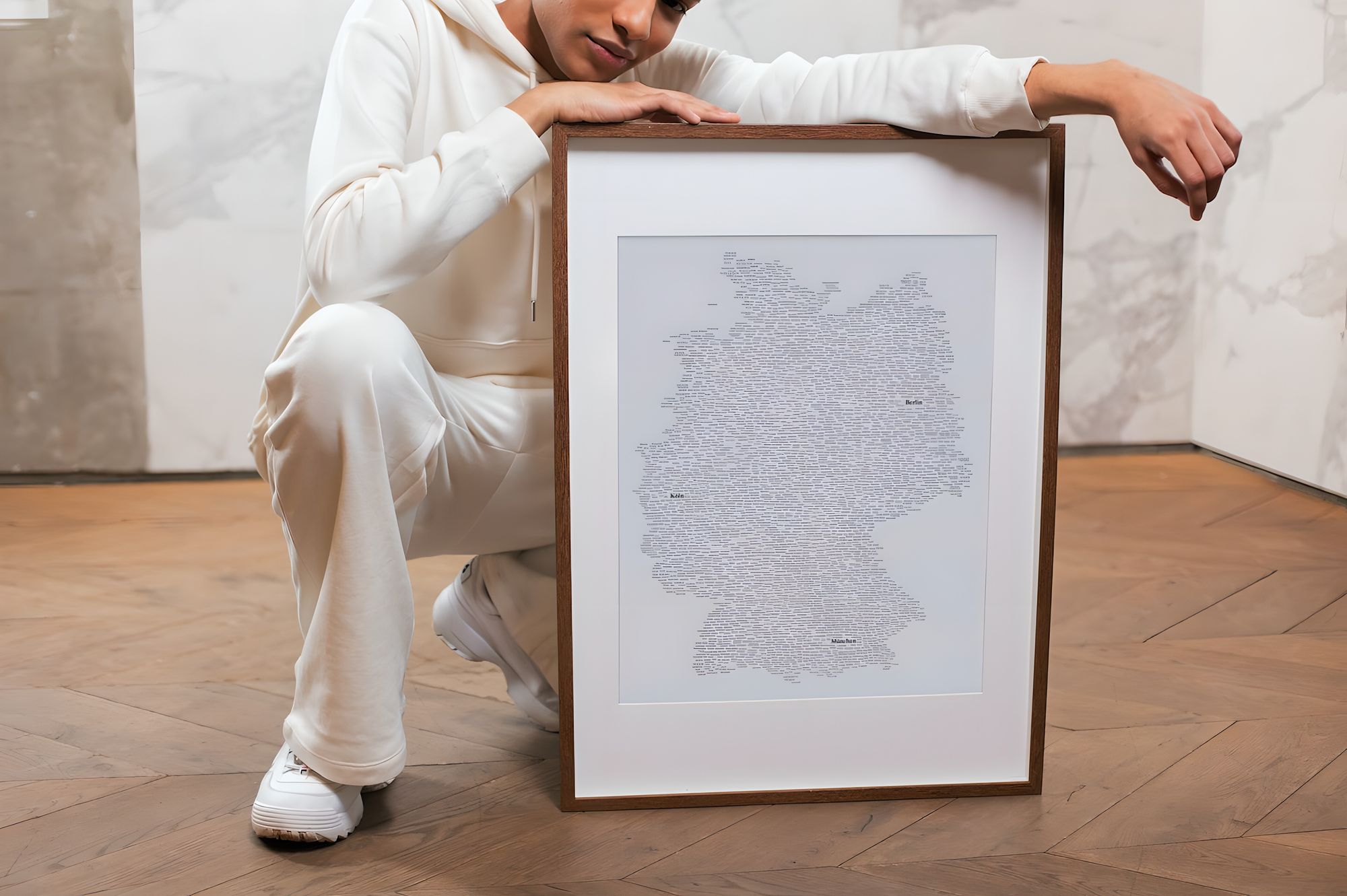
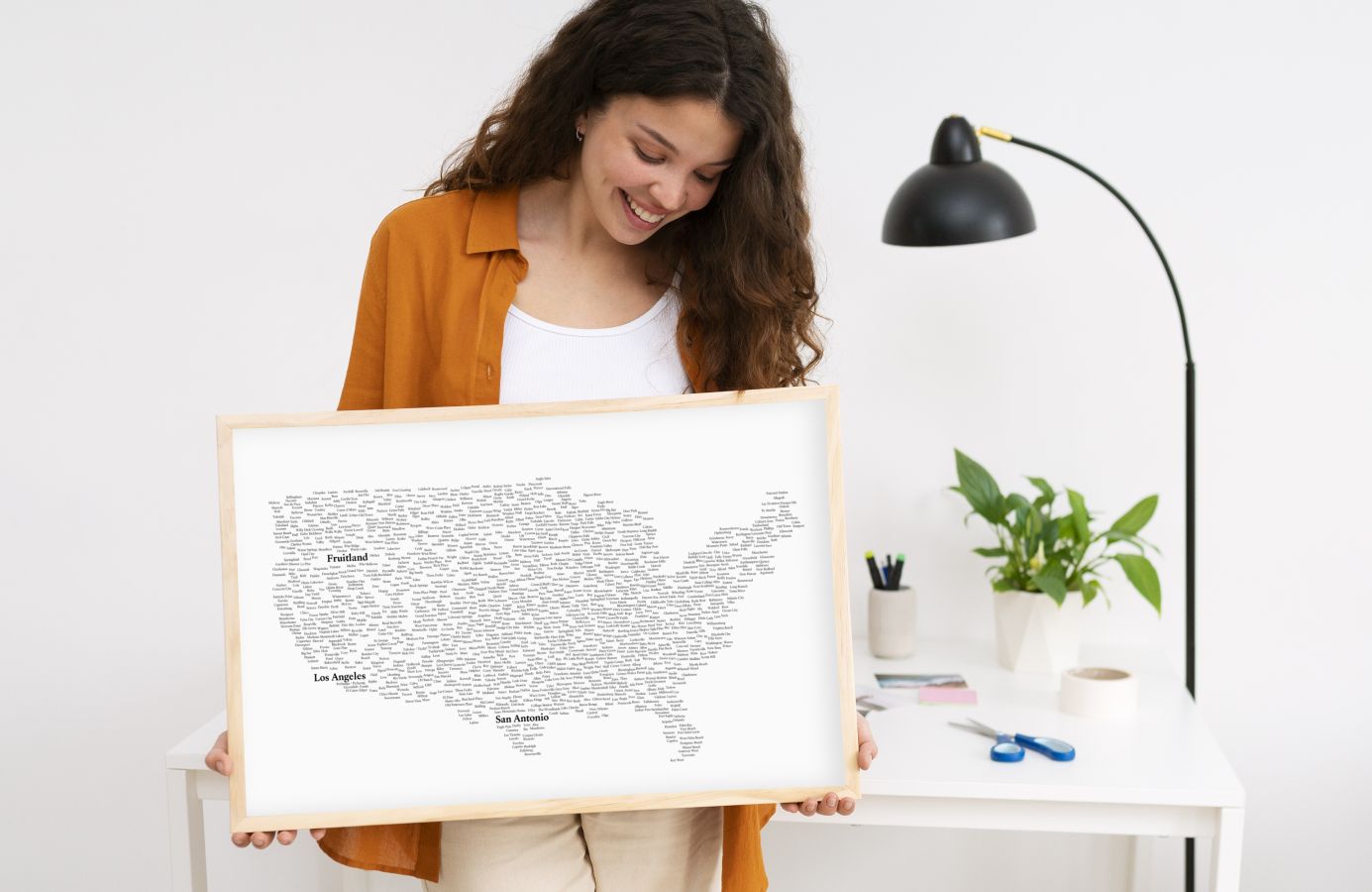
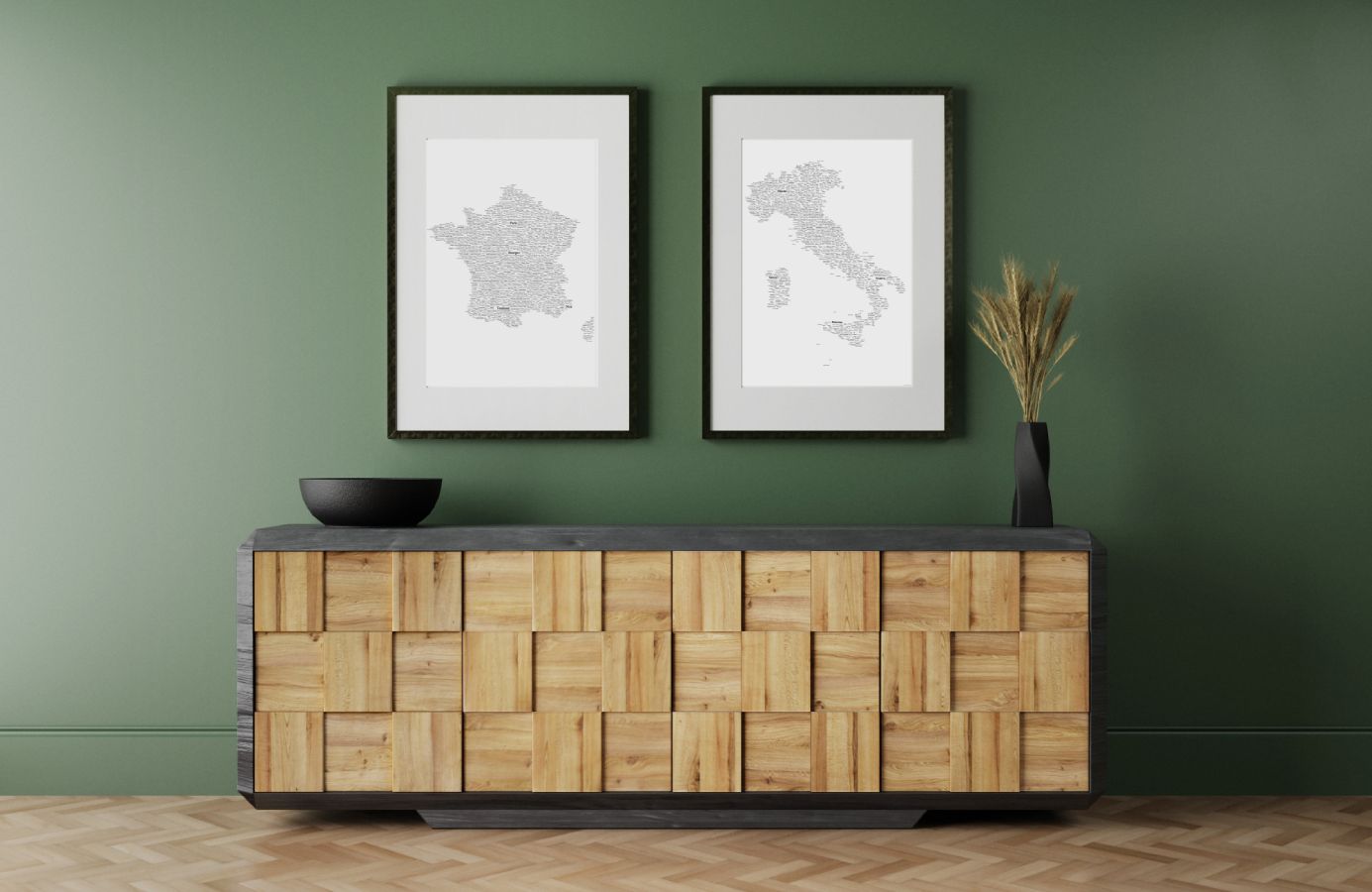
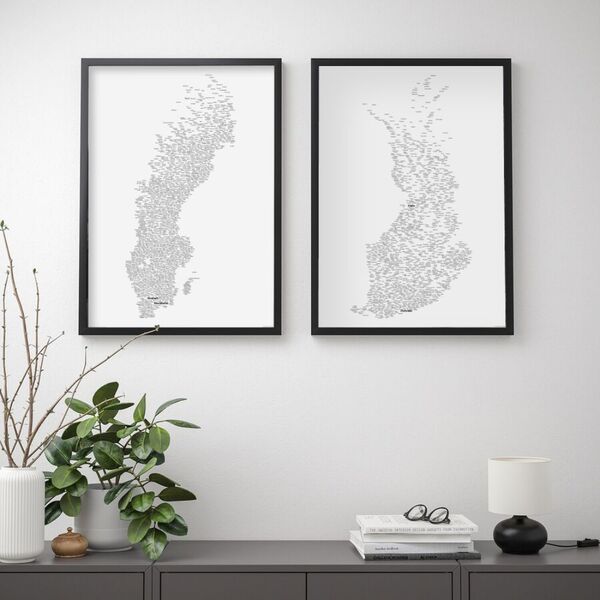
YourLovely.Place forms the silhouette of a selected country or available region from settlement names. You can highlight up to ten important towns or cities in larger, bolder text. Check that the country and the places you need are available in the designer before settling on the idea. Each poster covers one country or available region; it does not combine several countries into one map.
Example of a finished typographic map. The digital file is sold separately from printing and framing.
Make the design easy to live with
Choose a palette that fits the recipient’s room rather than the company branding. A quiet background can be easier to place alongside existing furniture. The designer offers nine palette presets and a custom background colour, with text adjusted for contrast. Use the zoom preview to check the highlighted place names, including spelling and accents. Ask one other person to proofread the design.
Pick the format with the wall in mind. A3 is easier to accommodate in a smaller room; A2 gives the place names more presence; A1 needs a suitably generous space. Cut paper to the intended dimensions and hold it against the wall if you can do so discreetly. Portrait and landscape layouts are available, so compare both before paying. The room preview is useful for judging the overall effect.
Keep the dedication separate from the map
Names, retirement dates, company logos and custom messages cannot be added to the map itself. Put the team’s dedication in a separate card. This also gives colleagues room to write something specific: what the recipient taught them, a moment of generosity, or a project they were glad to share. A short true memory is more meaningful than a long borrowed quotation.
If several offices took part, let each office contribute a few lines to that card. The map can carry the places; the card can carry the voices. This division keeps the design readable and avoids squeezing an entire career into the poster. Ask contributors to send their final wording by the collection deadline so the organiser is not chasing messages during the farewell lunch.
Arrange printing as part of the present
After purchase, the design is supplied as high-resolution PNG, PDF and TIF files for the chosen size. Printing and framing are arranged separately. Send the original file to the print shop and confirm the final dimensions, paper and deadline. Ask them to preserve the complete design rather than crop it to fill a differently shaped sheet or frame.
If you give only the digital file, explain that clearly and make sure the recipient is comfortable arranging a print. Otherwise, do that work for them: a keepsake should not arrive as an unexpected errand. Keep a copy of the original file and the printing instructions so that a damaged print can be replaced without trying to recover an attachment from an old group chat.
Present it with one simple explanation
At the gathering, explain why you chose the places in two or three sentences. Let the recipient look at the poster before passing it around. Do not turn the handover into a quiz about whether they recognise every location. If they prefer a quiet goodbye, give the present privately with the card and offer to send the other messages afterwards.
Before the day, check the file, spelling, frame size and meeting time. The strongest version of this gift is straightforward: a map they would like to keep, places they recognise as their own, and colleagues who can explain why those places matter. Start with the country preview on YourLovely.Place only after you have those answers.